


The town had no name worth recording. It sat where the railroad spur ended and the mine tailings began, a cluster of warped structures shedding paint like snakeskin. The year does not matter. The sky hung low and red with dust from the smelters, and the wind carried grit that settled in teeth and eyelids. Two people met there in a room above a saloon. They were not young. They did not speak much. What happened between them happened quickly and left marks neither could wash away.
Morning brought the federales. They came for someone else but took whoever looked wrong. The man was dragged into a livestock car with eighteen others, all bound for the labor camps near Piedras Negras. She watched from a window until the train became a point, then nothing. She left before noon with a shotgun and a canteen, heading north into country that killed slowly.
She believed him dead. This was reasonable. Most who went south did not return.
He believed nothing. The camps took thought from men the way heat takes moisture. Five years breaking limestone in leg irons. Seven more sorting ore with hands that stopped closing properly. When they released him his hair had gone white and one eye saw only shapes. The parole office gave him a bus ticket and forty-eight dollars. He rode north because south held only worse.
The cantina appeared first as a smear of neon against the evening haze. It stood alone where two state roads intersected, surrounded by creosote and rusted guardrails. The parking lot held three trucks and a sedan missing its rear window. Inside the air was dense with cigarette smoke and the smell of spilled beer gone sour. A jukebox in the corner played corridos, the same ones from thirty years prior with different singers.
He took a table near the back. Ordered coffee. The waitress brought it in a chipped mug and did not look at his face. He spread the parole papers on the table and tried to read them but the words would not hold still. His hands shook. This was permanent.
The door opened. She came in for water, he supposed, or to use the restroom. She stopped three steps inside. He did not look up immediately. When he did she was staring at him with an expression he could not parse. Her face had been remade by sun and years. Deep lines bracketed her mouth. Her hair was gray and pulled back tight. She wore jeans and a denim jacket with the cuffs frayed.
He said her name. It came out wrong, rusty.
She walked to his table and stood there. Did not sit.
You, she said.
Yeah.
They said you were dead.
They say a lot of things.
She pulled out the chair and sat. Her hands were calloused, nails short and clean. She folded them on the table between them. Neither spoke for a long time. The jukebox cycled through two more songs. A truck started outside and pulled away.
You look like hell, she said.
You don’t.
This was a lie. She knew it. He knew she knew.
What are you doing here, she asked.
Bus came through. Needed to stop.
She nodded. Looked at the papers on the table.
Parole.
Yeah.
How long were you in.
Twelve years. Little more.
Jesus.
He shrugged. Drank the coffee. It was bad but hot.
I had a kid, she said. Girl. She would be thirty-one now.
The words sat between them like a third person. He looked at her. She looked at the table.
Mine, he asked.
I don’t know. Probably.
Where is she.
Gone. Died when she was six. Fever.
He nodded slowly. Did not ask more. There was nothing to ask that would change the fact.
I’m sorry, he said.
She waved this away. It was old grief, worn smooth.
They sat. The waitress brought her water without being asked. She drank half the glass.
Why’d you run, he asked.
She looked at him for a long moment.
Because I told them where you were.
The words were flat. Factual. She did not look away.
He absorbed this. Nodded.
Why.
Because they would have burned the place down. Because I was scared. Because I wanted to live.
He considered this. Drank more coffee.
Makes sense, he said.
She blinked. Had expected something else.
You’re not mad.
Too tired for mad.
She almost smiled. Did not quite manage it.
The cantina emptied slowly. By nine they were the only ones left except the waitress and a man asleep at the bar. She had moved to his side of the table. Their knees touched under it. Small contact, accidental at first, then not.
There’s a motel across the road, she said.
I saw it.
She put a hand on his wrist. Her skin was warm and dry. He felt the pulse in her thumb.
They paid and walked across the parking lot. The motel sign buzzed and flickered. Half the letters were dark. She paid for the room with cash. The clerk did not look up from his magazine.
The room was what it was. Thin carpet, water stained ceiling, smell of old smoke embedded in the walls. They stood inside with the door closed and looked at each other. Not sure how to begin. They were not young anymore and their bodies had been damaged in different ways.
She took off her jacket. He sat on the edge of the bed and unlaced his boots. These were the same motions from three decades ago but slower now, clumsy with arthritis and scar tissue.
When he touched her it was with the memory of how it had been before overlaid on how it was now and neither quite matched the other. Her skin was loose where it had been tight. His hands fumbled where they had been sure. But they found their way. The old pattern reasserted itself under the changes. They knew each other’s rhythms still, buried under years of other hurts.
Afterward they lay in the dark and did not sleep. The neon sign outside cast red light through the curtains in pulses. She traced a scar on his ribs with one finger.
What do we do now, she asked.
I don’t know.
We could go somewhere. Start over.
He did not answer immediately. Thought about the parole terms. The forty-eight dollars. The way his lungs rattled when he breathed too deep.
I don’t think we get that, he said.
She rolled onto her back. Stared at the ceiling.
No. Probably not.
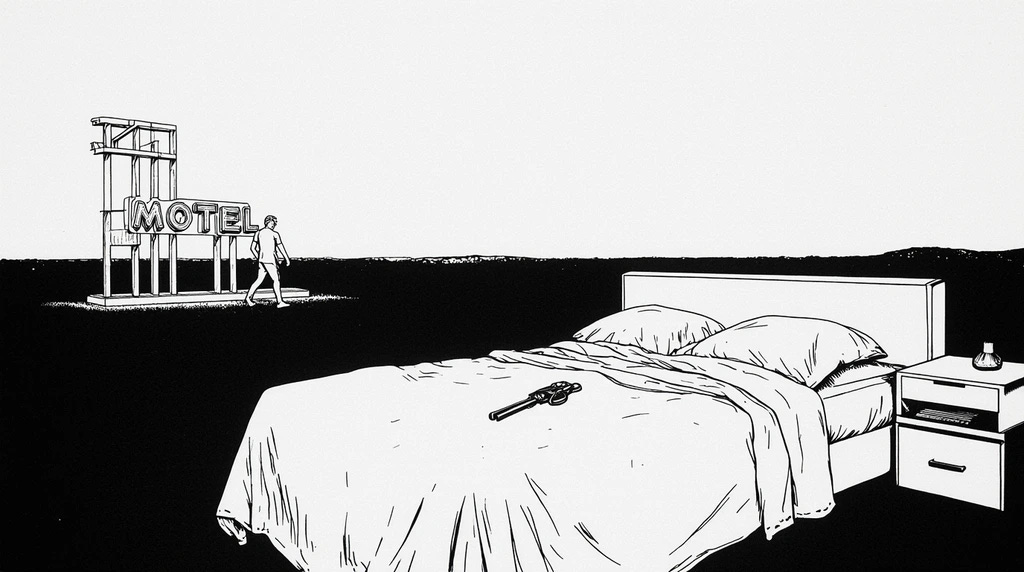
They lay there until the sky outside began to gray. She got up and dressed. He watched from the bed. When she was ready she took something from her jacket pocket and set it on the nightstand. A revolver. Old model, well maintained.
Finish it, she said. Or ride.
She left without looking back. He heard her truck start and pull away. He sat up and looked at the gun for a long time. Picked it up. Felt the weight. Set it back down.
The sun was coming up when he walked out. The desert stretched in all directions, empty and patient. He started walking. The gun stayed where she left it. Behind him the motel sign buzzed and flickered in the growing light. Ahead there was nothing but distance and heat shimmer. He kept walking anyway. This was all there was to do.