


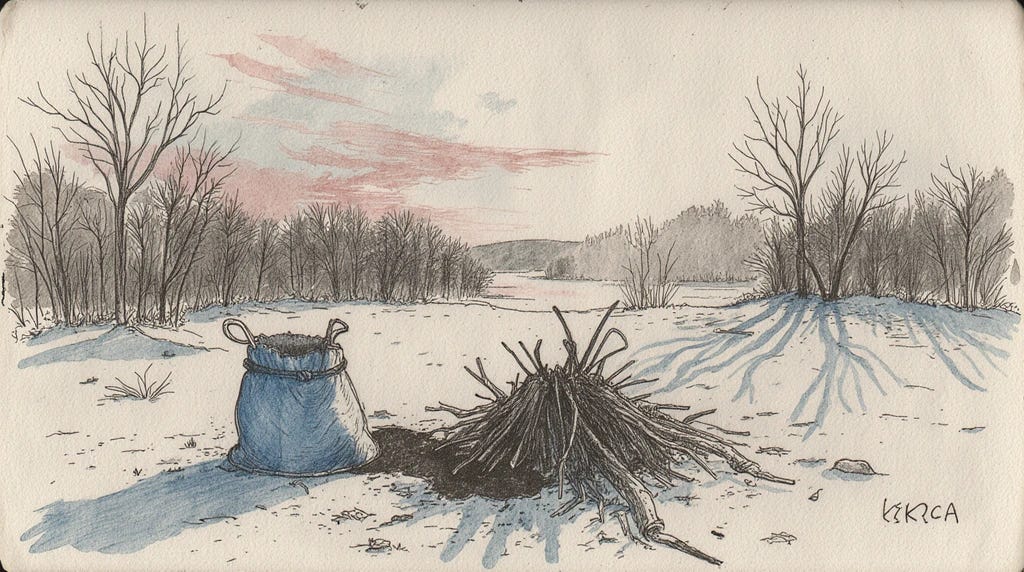
For those who carried what they should not have touched and for the earth that remembers every unwanted thing we tried to bury.
“The river is everywhere at the same time, at the source and at the mouth, at the waterfall, at the ferry, at the current, in the ocean and in the mountains, everywhere, and that the present only exists for it, not the shadow of the past, nor the shadow of the future.”
~~Hermann Hesse, Siddhartha
Holt came out of the timber around noon with his coat hanging open and his hands shoved in his pockets against the cold that wasn’t quite cold enough. He’d walked half the morning already and his feet ached. The sky hung low, a flat gray nobody would call a color, and the frost clung to the field’s furrows like it had forgotten to melt. Somewhere a crow called once and fell silent. The air carried a faint tang of wet dog and turned earth, nothing more.
He crossed into the clearing and stopped. There in the middle sat what might have been a grave or a woodpile or just a heap of dirt that had got ideas above its station. It wasn’t tall, maybe four feet long and mounded smooth across the top, with grass sprouting on it thick and green while everything else stayed rimed white. He stood there a minute, rubbing his jaw. His stomach growled. He wished he’d packed more than the heel of bread and a tin of pork fat that was mostly fat.
Holt went over slow. He knelt and put his ear to the ground. The soil was damp and cool against his cheek. After a while he heard it, a low thump, steady as a pulse but slower, heavier, like some big animal breathing deep under the hill. It went on and he listened until his knees cramped and he had to shift. He told himself it was just a sinkhole settling or water moving underground. Men hear what they need to out here. He almost believed it.
Three days earlier he’d been coming down the ridge with the others. They’d been out hunting since first light and found nothing worth the powder. Cole led with the sack slung over his shoulder, thumping soft against his back. Reddin walked point, rifle crooked in his arm like he expected trouble from the weeds. Holt trailed, tired already, thinking about the pint of whiskey waiting back at camp and how his left boot pinched worse than the right.
They’d picked up the sack two days before that, down by the ford where the river shallows out over flat stones. Cole spotted it first, half-buried in reeds and mud. Looked like somebody’s garbage, a bundle wrapped in sacking and old rags. Reddin poked it with his rifle barrel. The thing inside twitched. They all saw the movement, small and blind, like a litter pup that hadn’t dried off yet.
Holt bent and threw up in the shallows. Cole made the sign of the cross and looked away quick. Reddin just squatted and untied the cloth. What came out didn’t look right. Skin dark as mud, slick, with limbs too many or too few depending on how you counted. No proper head, just a wet knot of flesh that pulsed once and went still. It weighed next to nothing but felt heavy in the hand, warm where it shouldn’t be. Smelled like blood mixed with wet dirt and something sweeter underneath, like spoiled milk.
Cole said they couldn’t leave it there for the dogs or the current. Reddin wrapped it back up without a word and they slung it. Holt wanted to ask what the hell it was but his mouth stayed shut. They walked on and the sack knocked against Cole’s back the whole way, soft as a heartbeat.
Now in the clearing they saw the brushpile first, a rick of dead sticks and limbs stacked crooked where the trees gave out. Frost silvered it like bad money. Then the woman stepped from behind it. She wore a coat too thin for the weather, hair matted with rime, face pale and set like she’d been waiting since supper the night before. Holt figured her for a farmwife gone wandering. He was wrong about that. He stayed wrong a long time.
Cole pulled up short. You shouldn’t be out here, he said. His voice came out thicker than he meant.
She looked at him steady. You sent for me.
Cole blinked. He hadn’t sent for nobody. Still, the words stuck sideways in his head. Holt hung back, wishing for a smoke. Reddin kept his eyes narrow, thumb on the rifle hammer.
We found something, Cole said. Don’t know it’s yours.
She nodded at the sack. Where.
Holt spoke up before he thought better. Down by the ford. Riverbank.
Reddin shot him a look. Too late now. The woman tilted her head like she’d heard enough.
You took it from the water, she said. It don’t belong in the air.
Cole shifted the strap on his shoulder. The sack felt heavier sudden. We figured it for dead. Couldn’t just walk past.
Her eyes found his and held. He looked down at his boots, scuffed and caked with mud from yesterday’s tramp. Something twisted in his gut, old and nameless.
Didn’t know till we looked closer, he said.
She watched him a beat. You looked plenty.
Reddin cleared his throat, a wet rasp. He hawked and spat into the grass. The gob sat bright red on the white frost. Folks talk like they own what’s washed up, he said. Like the river’s their trash heap.
She turned slow. Her breath came even, no cloud in the cold. Reddin met her eyes and for a second Holt thought he’d back down. He didn’t.
It ain’t yours to claim, Reddin said. Never was.
The words hung there plain as talk over coffee. Then the air went thick. Wind kicked up from nowhere, rattling the brushpile. A dry snap came from inside it, no match, no flint, and flame licked up the sticks, pale blue and silent.
Holt’s mouth went dry. We never lit that, he said.
The fire spread quiet, climbing limbs and licking at her heels without smoke or crackle. It took her coat hem and hair but left no char. She didn’t move. Cole fumbled the sack off his shoulder. It hit ground and split, spilling mud and rags and the thing in the middle.
It had grown or changed or just shown what it always hid. Pale now, limbs stretched wrong, fingers scraping slow in the dirt. No mouth opened but a seam wept black fluid. The stink hit them all at once, rank sweet copper, thick enough to chew. Holt gagged again. Cole staggered. Reddin stood fixed, face gone white around the eyes.
She walked through the fire toward Reddin. Flames trailed her like wet cloth. Her skin gleamed where they touched, smooth and wrong. She raised one hand, pointed. Shadows of other hands lagged behind it, faint echoes.
Words were given, she said.
Fire ran her arm. Reddin’s rifle half rose. He swallowed hard. Only ruin, she said.
Wind howled low through the trees, carrying a thin wail. Frost boiled off the ground in steam. Holt backed up and felt the sack twitch underfoot, damp pulse climbing his leg. He kicked free. The treeline pressed closer, branches hooking like bad barbed wire.
Cole knelt clutching his head. Reddin jerked when the thing’s fingers grazed his boot, no mark left but he twitched like stung. The rifle dropped from his grip.
Then nothing. Fire sucked inward with a hiss. Ash ringed the pile, woman gone with it. Light came back flat and used-up. River fell silent down the hill.
Reddin picked up his rifle first. He walked out without looking back. Cole hauled himself up, legs shaky, and followed. Holt lingered till the twitch in his boot sole quit. The spilled mess settled into mud. He turned away.
They topped the ridge as frost melted off. Fields below looked greasy under weak sun. Dead bugs littered the road ditches, whole and dry. Nobody spoke much. Holt’s boot pinched worse.
Evening brought them to the river again. Water ran dark. Reddin waded in mid-calf, then knee. Halfway across he stopped dead. Cole called once. Reddin turned like to answer. His mouth filled with river.
He buckled slow. Eyes rolled white. Current dragged him down quiet. Cole splashed in, cursing the slip of stones underfoot. He hooked arms and pulled the body shoreward. Reddin flopped pale on the rocks, water trickling from nose and ears. Chest rose once, faint.
Holt slid down the bank. He breathing?
Cole pressed a palm flat. Yeah. Barely.
Water gathered on skin, beaded into shapes, crooked marks. They watched it form her name clear as day, then rinse away.
Night came without stars. They built fire in birch groves two miles up, trunks ghostly white. Holt dozed fitful, waking to prod embers and check his own breath. Cole sat staring into dark, jaw working on nothing. Dawn he rose sudden. Grabbed his rifle.
Where to, Holt mumbled.
Gotta put it right, Cole said.
He went back to the river alone. Water glowed faint from below. He waded deep, hands probing mud. Found purchase on sack or memory of sack. Lifted empty weight. His face stared back warped in the surface, mouth gaping silent. River took him next. Quiet. No thrash.
Holt walked the road out three days running or maybe five. Heat settled wrong for January, thick air holding no birdsong. His boots split at the seams, feet raw inside. He turned back to the clearing one morning because it felt like the thing to do, or because dreams wouldn’t let go.
Grass filled every scar. The mound sat same as before, darker soil, flies circling wide. He knelt unthinking, ear to earth, heart thumped below, syncing slow with his own till they matched.
Tears came. He wiped his face on a sleeve stiff with salt. Sun cut the ridge, steaming frost. Wind muttered at the treeline, you shouldn’t be here, like an old gripe.
He stood. Walked off. The thump faded but stayed, road ending underfoot while the river murmur trailed patient behind.
Author’s Note:
This story started with a Reedsy writing contest prompt about “discord,” that moment when words go wrong and you can’t pull them back. I took it and ran it through a lens that looks at the way men mess with things they shouldn’t touch. The three hunters find something awful by the river, say the wrong thing to the woman who claims it, and everything unravels from there. I wrote it over a few days, aiming for that slow-burn dread where the land itself turns against you. I kept the voice distant and cold but dialed it back some, added sore feet and empty stomachs, the small stuff to try and make the characters feel real. No big research, just rereading books and remembering walked riverbanks to get the mud and cold right. The sack-thing isn’t based on anything true, it’s pure made-up horror, the kind that sticks because it’s half-seen. Fact is, rivers do wash up junk that looks human for a second till you look closer. Fiction took it darker. One choice, time loops a bit through Holt’s eyes. He hears the heart first, then we flash back. It’s not perfect order because memory isn’t perfect. The woman’s words, ”Words were given. Only ruin,” that’s the pivot, the discord that damns them. No heroes, no lessons. Just consequence.
Thanks for reading it through. Means a lot.
-lokikone
This is really good, Lokikone 😲👌🏼I’m a fan now.