


Per me si va ne la città dolente,
per me si va ne l’etterno dolore,
per me si va tra la perduta gente.
~~ Dante Alighieri, Inferno
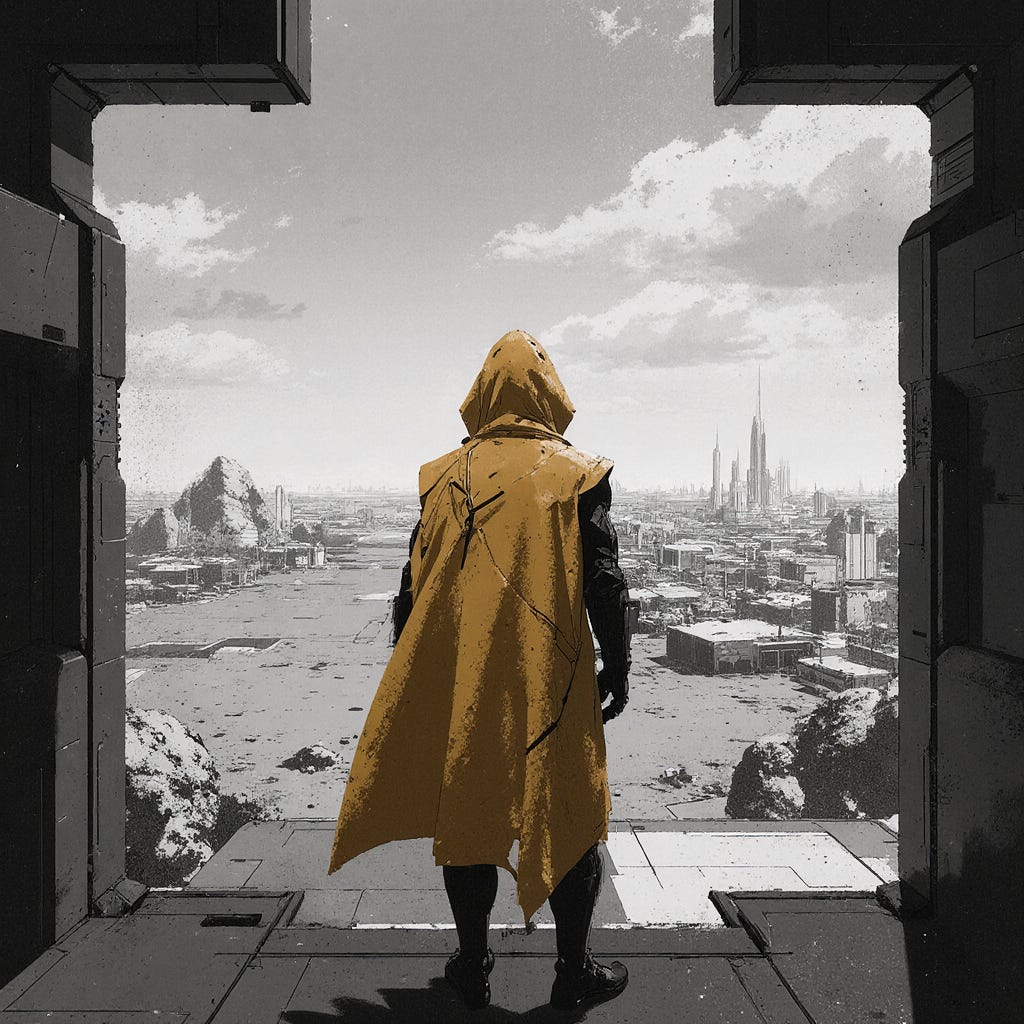
To whoever remains among the living,
I am already gone. Gone does not mean dead. Not always. But close enough that the difference no longer bears weight in the scales. The city will say I was traitor and aberration and that I lost my purpose. Let them. Men who live behind walls have to pretend their wardens are saints or they come apart. Nobody builds statues for the ones who turn around and hit the stone.
I write this in the tunnels under the city. Pipes sweat above me and every drop falls on the metal floor with the same small, patient sound. It reminds me of the clock I had as a boy, the one that stuck on the same minute for three years and still insisted on being believed. I used to think time was a straight road. Now I know it folds like the ducting down here. Around grief. Around guilt. Around the memory of a child burning beneath a false sun.
Officially, the city stands on virtue. That’s the slogan, carved over half the doors. In practice, it stands on fear. Fear of sickness. Fear of hunger. Fear of the crooked shapes that walk the waste. Steel and virtue, they said in their high offices. But men don’t hide behind armor because they’re nobles. They hide because they are afraid and rich enough to do something about it.
Fifty years before I was born, the Collider spoke. That’s how they tell it. One word, they say, and the world split down the middle. They built whole churches out of that rumor. I never believed it was a word at all. I think it was the sound of the universe drawing a breath it had long been denied. Everything after has been an exhale.
Some people rose up changed. Some stayed ordinary. Some stayed on the floor and didn’t move again. The changed fenced off a section of the world and called it the metropolis. White towers, clean lines, a soft electrical hum that never went quiet. They sealed it and named it salvation. Those left outside they called lost. The land beyond the perimeter went strange. Soil scalded, animals twisted, machines half‑awake in the dust. The city’s towers cut the sky like the ribs of some beached leviathan. Under that cage, people shopped, worked, fed themselves without ever seeing the soil their food came from. They walked in light that never dimmed and thanked the watch on the walls for keeping the nightmares out.
The blessed ones, as the pamphlets liked to say, walked the parapets with the steady composure of people who had never been told no. Their eyes had that low banked glow of a furnace at idle. Their hands closed around a man’s head the way a kid closes around a boiled egg. They looked out upon the waste and said that it was their kindness that kept them from descending. I have met mercy. It does not wear that uniform.
I wasn’t one of them. I came up plain. I was dust-born. Ordinary blood. In a city that worshiped wiring and miracle, I was meat in work coveralls. I spent my days in the lower wards, greasing gear teeth, clearing blockages, another anonymous shape in a crowd of tired faces. There was a boy who believed in capes and legends and the bright lie that the strong would always come when called. I won’t write his name. The world already took it and did not give it back.
When recruitment came, it arrived in the form of three men with clipped hair and clipboards. No speeches. No banners. They needed bodies for the conversion line, fuel for the machines that underpin the wall. They promised no life, only purpose. Purpose is just death with a prettier face. It was enough.
I signed my name, then crossed it out. Handed them a number. I felt something slip, like a loose tooth finally letting go. You might call it erasure. To me it felt like shrinking my world to a size I could lift. A man with no name cannot be summoned back by the dead.
In the white‑tiled rooms below, they took our clothes and our hair and a good portion of our dignity. Wired us into their devices. The machines there didn’t sound like tools. They sounded like animals that had learned to suffer. The doctor fastening restraints at my wrists had the look of a man who had argued with himself once, a long time ago, and taken the easy side. He asked whether I had anything I wanted to confess. Confession is for those who think there is anyone left to absolve them. I kept my silence.
The needle bit. Heat flooded my veins like something with its own intention. My bones felt as though they were being rewritten. There was no language for the noises those nerves made. Then all of it burned away into a vast and weightless dark.
Somewhere inside that dark a pulse began. A heartbeat, but not mine. Mechanical. Patient. Older than the city and less merciful. When I woke the world had tilted just enough that everything sat wrong. I felt the new angle of it in my teeth. The air was edged. The light was wrong. I touched the steel table and watched the surface sag and crumple as if it had been left out in the rain too long.
There is a moment when the mind meets the impossible. It either shatters or bends. I held together. The cracks would come later.
Something laughed in my chest. A voice I knew turned thin and strange, warped across frequencies that scraped the bone from inside. I stood up and found a mirror. The face looking back was mostly mine, but the eyes had lost their usual clutter. The focus in them had gone hard and still. I did not find much to smile about afterward, and when I tried the expression felt borrowed.
They sent us to the walls. Fresh stock. New line of defense. Men wired into engines. We took our places beside the older Guardians, those near‑mythic figures from the posters. They barely glanced sideways. To them we were scaffolding around an older statue. To the city we were collateral. If we survived our service we would become them. If we died we would become a number in their statistics, a necessary loss, a noble cost. The arithmetic of power is always neat on paper.
Then came the breach.
You know the official story. Children taught it in schools, priests muttering it at altars of glass. A breach, they say, a rush of monsters, a righteous response from above. Casualties regrettable but unavoidable. The narrative is tidy. Reality wasn’t.
The boy ran first. Of course he did. He had spent his short life being told that if he shouted loud enough, someone in a bright emblem would hear and come down like a blessing. Sirens screamed. The gap opened. Things from the waste came through like water where the dam has hairline cracks you never bothered to fix. Limbs wrong, backs wrong, moving the way broken machinery moves when it doesn’t know it’s finished. Emergency lights went red. In that strobe, every shape looked worse.
Then salvation arrived. One of the high ones dropped out of the clouds with a cone of white around him, the way the murals always painted them. He lifted his hand, and the world lost its color. The creatures burned. So did everyone standing near them. So did the boy. When the light shut off, there was a layer of pale dust where people had been, and a smell like overcooked sugar that settled in the back of the throat and would not leave. For a heartbeat the scream hung there with nothing left to carry it. Then that, too, was gone. The city systems reset. The anthem came back on the speakers. The incident went into the files as an unfortunate necessity. They called it mercy in the morning bulletins.
Something inside me went missing that day. Not cleanly. It felt more like an organ failing quietly and then collapsing in on itself. You do not see that sort of absence in a mirror. You only learn its shape from what keeps falling through. I stopped sleeping. I started walking.
Under the factories, under the office stacks, the old smuggler routes still run, half‑mapped, half‑forgotten. Stone, rust, the occasional drip from a pipe that doesn’t remember its function. The air down there smells of copper and waste and wet earth. The walls carry the sheen of hands that once believed there was an exit ahead if they just kept going. Not all of them were right. I followed those halls until the sound of the city above died and the silence took its place like a slow and patient tide.
Outside the walls the world does not lie. The creatures there do not preach salvation. The creatures kill when they are hungry and curl up when they’re not. No speeches. When they came at me with their dry, airless hissing, there was no negotiation. My hands met bone with a new kind of force. The power they had seeded into me jumped eagerly to the surface. Each time I called on it, skin blistered, blood raced, something essential burned down a little further. It didn’t feel like heroism. It felt like paying a bill in exact change. Hot blood on cold knuckles. The plain transaction of bone and violence.
Pain slows thought. It strips it down to what you can’t talk yourself out of. Hit after hit, it became obvious that none of my blows were just for those things in front of me. Every strike landed on the city, too. On the man in the sky who burned a boy to keep his story neat. On the part of me that had told the boy those stories. The waste gave back no answers. Only more sand, more ruin, more creatures that did not know enough to lie.
Months slid past without anyone using my name. I watched the city from beyond the reach of its own propaganda. From out there, the Guardians looked like well‑made machines on rails, moving according to a script, lit by some central helium heart. I learned their routes. Their habits. Where their perfection grew thin. A system is like a body. It has weak places. I marked each one and waited.
When I returned within the walls it was dawn. That hour has always belonged to people who decide to finally do the thing they’ve been putting off. I walked in through maintenance hatches and unmanned gates. The alarms, tuned to expected threats, ignored the familiar signature in my blood. I moved through blind corridors and unused stairwells like I’d drawn them myself. In a way, I had. They had built me, I was their oversight.
At the center of the inner spire, in the high chamber with its polished floor and observation glass, stood one of the originals. Gold edging on his armor. Emblem bright. He was alone with his reflection, rubbing a cloth over that stylized symbol on his chest as if he could polish the world into order by keeping it shiny. I said his rank once. He turned. Recognition broke across his face like light across rusted metal.
He tried to wield words. They came too late. My arm moved before he could wrap them around himself. The first hit dented metal and bone at the same time. The second broke stone out of the floor. Each strike carried with it that vanishing scream. The face of the boy, the burn of the light, the white streets after. Rage became ritual. The world shrank to impact and fracture.
He fell at last. When the armor cracked and fell away, what lay inside it was just a tired man whose belief had carried him further than his imagination. The shoulder lights winked out, leaving his face bare. Accident, he said. We save the many. His breath smelled like old blood and old sermons. The idea he clung to had clearly been handled by a lot of hands before his.
I closed my hand around his throat. It would have been easy to finish it. End the holy story right there by ending its loudest mouth. But the look in his eyes mirrored something I recognized too well. Purpose had hardened in both of us into something brittle and absolute. He had sacrificed in the name of order. I in the name of destruction. Different scriptures. Same god. Necessity. That awareness hit harder than any blow I had thrown. Something laughed again inside the current, a thin, crackling sound that did not belong to either of us. It ran along my ribs like static. It was not a child’s laugh, not anymore. It was older and stranger, a sound carried on the Collider’s forgotten word. For a moment that sound was almost forgiveness. I could not bear it.
I let him live. I turned instead to the machines. Racks of monitors, arrays of sensors, the nervous system by which the city watched itself and called that vigilance compassion. I took them apart with my hands. Glass went. Housings buckled. One by one, the screens went dark. Feed after feed cut off. Somewhere above and below, cameras blinked out and nobody was there to see it happen. In the middle of the room, the city crest lay inlaid into the floor in metals from a dozen scavenged ages. I set my hand to it and the metals ran like wax. The symbol of their salvation collapsed into shapeless slag.
Tell them, I said to no one. Walls save nothing. They only teach monsters to wait.
The sirens finally decided I mattered. They howled up and down the column, the sound thin with static. I was already in the stairwell, feet taking steps I no longer needed to think about. Outside, the skyline bled at the edges. The sound beneath the pavements had changed. Somewhere in the pulse of pumps and fans there was an off‑beat, a question nosing around the old certainties, what if the wall itself was the illness. Questions are stubborn. Once they arrive, they rarely leave just because you ask politely.
Each time I used the power I felt it eat away at me. Five years, they had said, if the flesh holds. The flesh was holding. The years didn’t. The math was obvious but I had stopped caring about sums.
I went back out through the breach lines. Behind me, the neat machine of the city shook in slow motion. Emergency signals drifted out of sync. Someone dropped a tray in a cafeteria and nobody bent automatically to pick it up. People stood in doorways with their hands empty, realizing they didn’t remember what they usually held. Some will decide I did them a kindness. Others will put my face on notice boards and teach their kids to spit when they pass. Both are wrong. I did not come to free them. I came to break the mirror and make them look.
Out in the waste the mutants circled back to me as if drawn by some shared remainder of that first word. Maybe the residue of that first signal leaked off me the way heat does. We met over and over. My skin burned differently now. The power and the damage had grown used to each other. They tore strips from me and I let them. A bruise here, a deep cut there. Each mark carried some small piece of clarity or at least the simple dull peace that comes with being too tired to think. Scrapped engines half‑buried in the sand woke sometimes in the wind. They vibrated at a pitch that raised the short hairs on my arms, a ghost of the Collider’s voice playing to an empty room. Perhaps that is all that remains of it now. A voice whispered to the bones of the world.
You who read this, if any ever do, must not mistake me for a savior. I did not come to open gates and shepherd anyone through. I’m keeping the books. If they rebuild, they’ll call it repair. If they collapse, they’ll pick a word like cleansing. Humans rename their own disasters the way they rename streets, until the old ones become trivia. The truth is simpler. Those with power built the walls to give their fear something solid to lean against. Fear goes through concrete the way damp does through old cloth. It stains right through. The best you can do is slow it down.
I used to think vengeance was direction. I know now it is only a door. Past it there is only whatever you bring in with you and the sound of your own footsteps. Standing over the ruined crest, I felt no sense of completion. Just recognition. The pattern unfolding one more time. Every era ring‑fences itself, crowns its protectors, points at something outside and calls it monster. Then someone eventually gets tired enough or angry enough to swing something heavy at the supports, and the whole arrangement collapses into dust and argument. New walls go up around the rubble. The names change. The posture doesn’t.
Still, I wonder if in the crack between one cycle and the next something new could crawl out. Not pure. Cleanliness is another way of saying nobody bled where you could see it. Just honest enough not to pretend the cost isn’t there. That would be enough.
The other altered soldiers sometimes vibrate with the Collider’s cadence, like sleepers mumbling through the end of a bad dream. I hope it never fully wakes them. A dreaming weapon is less dangerous than one that believes it is a man.
There was a night when the howling in the waste went still. The horizon lit up flat white, like someone had opened a door in the sky and flooded everything with hallway light. For a breath I thought the city had finally dropped under its own weight. Then the brightness steadied, and I understood. It wasn’t dying. The world exhaling yet again. Maybe that is all history is. One long breath through gritted teeth and a sigh through scaffolding.
If there is any god yet listening, tell him this, fortresses raised out of fear rot from the foundations first. Mercy that allows no choice is only control with a kinder font. The creatures beyond the wall, twisted as they are, deserve whatever narrow, strange light is theirs without someone else filtering it.
I am not asking for forgiveness. I do not believe such a currency exists. What I want on record is simpler, there was a moment, no longer than a heartbeat, when the great grid of defenses and uniforms and sanctioned fire hesitated. For that instant, it saw itself clearly enough to recognize that its perfect streets were held up by small bodies that never asked to lie down there. That instant cost me most of what I was before the syringe. The price seemed fair.
There is movement outside the tunnel now. Wind or something larger. The horizon thins. The air tastes of ozone and old iron. Maybe it is an ending. Maybe only another experiment. Either way, I intend to meet it the way I have met everything since they erased that boy with a beam, forward and unsuited to prayer. If they build their walls again after I’m gone, tell them to leave gaps. Air goes stale in sealed rooms. So do people. So does whatever passes for truth.
I will lay down this pen. The oil is almost gone. The old devices beyond the tunnel mouth are coughing themselves awake, like animals with bad lungs. Remember this one thing if nothing else sticks, salvation is a story the comfortable tell themselves at night so they can sleep. The only thing the city ever truly feared was not the mutants or the waste or the word the Collider spoke. It feared men who stayed awake.
~~The Last Volunteer
Written for Power Up Prompt #21 from Bradley Ramsey.
Special thanks to Priya Hinduja and David Braziel!
The intro dedicated to Dante is fantastic. Great choice for a nice post.
Excellent post I was riveted!