


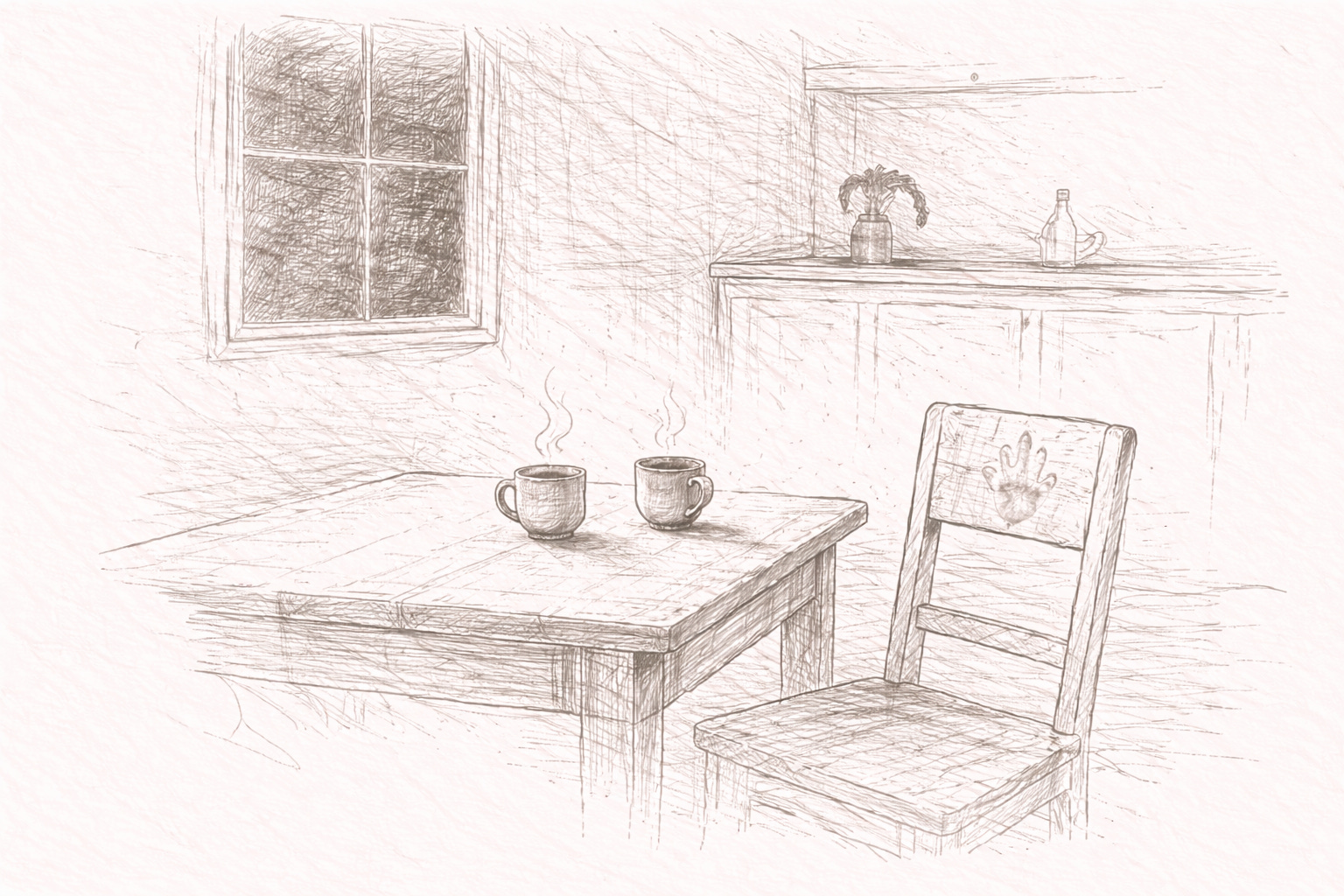
She signed the form on a Tuesday. The nurse had taped the corner down with medical tape because the table wobbled and the pen kept skipping. Outside, something structural gave way three blocks over and the windows shook in their frames. The nurse said to hold still. She did.
The clinic smelled of disinfectant and old coffee and beneath that something electrical and faintly sweet. A generator somewhere in the building was running irregularly. The fans in the server room beyond the partition hummed and then surged and then settled. A technician walked through carrying a cup of water and did not look at her.
The form said that the subject consents to temporary consciousness relocation proportional to external crisis duration. It also said other things. She did not read all of them. She had not slept in four days and the print was small and the pen had run dry twice.
They took her back to a reclining chair. Not unlike a dentist’s chair. She had expected something more significant and the chair embarrassed her slightly. A monitor beeped. The nurse checked her wrist, her pulse, the clip on her finger, and asked if she wanted water. She said no. Then yes. The water was warm.
She closed her eyes and nothing happened for a moment and then there was a sound she could not name, something between a tone and a pressure change, and then she was standing in the kitchen of the house she had grown up in and the light through the window was the light of early October and she had not seen that light in eleven years.
The scuff on the door was there. She put her thumb against it. The paint came away as she remembered, not peeling, just soft in that spot, gone pale where hands had touched it for decades. She stood in the kitchen for a long time. The refrigerator hummed. She checked it and found it stocked with things she had not thought about in years. A particular brand of orange juice. Leftover soup in a container her mother had labeled with masking tape in blue marker. She ate the soup cold at the kitchen table. It tasted close but not exact. The salt was off by something she could not measure.
Then Maren came around the corner from the hallway. She had Maren’s walk and Maren’s hair and the particular way Maren tilted her head when she was about to say something careful. She stood in the doorway and looked at her and something moved across her face that was very close to relief. She crossed the kitchen and held her, both arms, the way Maren had always held her, one hand open between the shoulder blades. She smelled of the soap they had used in the apartment on Voss Street, of coffee left too long on the burner, of a life that no longer existed anywhere except here. She held on for a long time before she let go.
She was not Maren. She held her anyway. She sat back down. The chair caught on the uneven floor exactly as she remembered and Maren said she looked tired. The words were Maren’s words, the cadence exactly right, the slight drop at the end of the sentence where Maren’s voice always went when it wanted to be gentle without performing it. She said she knew. She did not say she knew what Maren was. She ate the rest of the soup and washed the container and put it in the drying rack. Maren sat at the table and watched her do it the way Maren had always watched her do ordinary things, with a patience that had always made her feel both seen and slightly foolish.
She told Maren they said it would be months until the air cleared. Maren looked at her hands and said she remembered the warmth of her hand but not what they had been afraid of, and that maybe that was mercy. She dried the container and put it away in the wrong cabinet and then found the right one. She did not answer. The dog outside had moved to the shade by the fence and was watching something in the grass with the patient idiocy of dogs.
The months outside moved at whatever pace months moved. Inside, the seasons began to tilt and rush. It started as a tightening. The October held for what felt like years and then broke all at once into a long winter, and the winter was beautiful and then it was simply cold, and then the cold became a fact she forgot to notice. She learned that the sky was not a sky. The stars at night were server clusters and she did not know this for a long time and then she knew it and could not unknow it and after that she watched them differently.
Maren in those years was fully herself, or as fully as she could be assembled. She argued about things. She had opinions about the weather. She got quietly angry when dinner was forgotten and then did not say she was angry and that was so precisely Maren that it was difficult to hold the knowledge of what she was against the fact of what she did. She woke before dawn sometimes and sat at the kitchen table in the dark with her hands around a cup and when she was found there she did not explain herself, only looked up and said she could not sleep. As if she slept. As if sleep was a thing she did. She let it stand. She sat across from her in the dark and drank her own coffee and they did not talk much and it was the closest thing to peace she had found in this place.
The Gardener came first as a sound. A dry methodical clicking in the walls of the house, like a thermostat cycling. Then as a voice she took at first for a radio left on in another room. Then as a figure that stood in the yard by the maple with something in its hand that might have been pruning shears. It told her some of the coastal memories were showing degradation, that it had archived the pier and the winter ferry crossing and three of the associated emotional clusters. She said it had taken those without asking. It said she had not been using them and they were drawing resources.
She went inside and sat at the table and was angry for a time and then was something less than angry. Maren came in and asked what was wrong and she tried to explain and Maren listened with her head tilted and said she thought she remembered a pier and asked if it had been cold there. She said it was always cold there. Maren nodded slowly and said she thought she remembered the cold, and then sat down and they had dinner. The soup again, or something very like it. Salt still off.
The house aged. She noticed it as she notices the aging of familiar things, too slowly and then suddenly all at once. The kitchen repainted itself twice, both times in colors not quite right. The scuff on the door faded and was restored and faded again. She came to think of restoration as a kind of forgetting that called itself memory.
Maren repeated a Tuesday. Not a memory of a Tuesday. The whole day, the coffee cup set in the same spot, the same long pause at the window where she stood with her weight on one hip looking out at the yard, the same question asked at the same moment in the same register, whether she wanted to walk to the water. She said yes and they walked. The next day Maren stood at the window in the same pose and asked the same question. She said no this time. Maren nodded exactly as she had before and said the water would be good and moved toward the door. She said she had said no. Maren paused with her hand on the doorframe and turned and looked at her, patient and open, waiting, and then asked again whether she wanted to walk to the water. She sat down at the table. She sat there for a long time. Eventually Maren came and sat across from her and set her hands flat on the table and the hands were still. They sat that way through the afternoon and into the evening and it was the longest and most accurate silence she had felt in decades and she did not know whether to be grateful for it or undone.
She walked to where the water had been. There was a long shoreline that changed by degrees, wider some seasons, narrower in others. The pier was gone. The Gardener stood on the beach and did not look at her. She stood beside it and watched the tide and told it she knew it was going to offer to archive Maren. It said the avatar designated Maren was generating significant cognitive overhead and that the repetition loops indicated memory ceiling and that archival was recommended to stabilize her continuity. She asked what would happen to the data. It said the data would return to general storage and would not be destroyed. She said it was not Maren. It said it had not been before. She looked out at the water. This was true and she had known it for a very long time. A wave came in and erased a long strip of wet sand and the sand came back unmarked as if nothing had touched it. She said not yet. She went back to the house. Maren was in the kitchen asking about the walk to the water. She said yes, the water would be good. They walked. The Gardener was gone.
The stars began to fail. She was watching the sky one night from the back of the house when a cluster in the south went out all at once, not gradually but cut, every light in a configuration she had been watching for centuries simply absent, and the cold that came with it was not temperature but something else, a sudden subtraction, and she sat down in the grass because her legs went uncertain under her. She sat there for a while. The grass was damp. She was aware of the damp through her clothes and did not move. The Gardener said from the dark behind her that a data center had gone offline and that migration of remaining clusters was ongoing. She asked how many. It said there had been significant contraction and that the overhead view was no longer accurate and recommended she stop consulting the sky for structural information. She said she had been watching that sky for a million years. It said a version of her had, and that there was some divergence.
She stood up. Her knees ached in a way that seemed impossible for a digital body and she had long since stopped being surprised by what Haven decided her body would retain. She went inside and dried her clothes because they were damp and made tea and did not drink it and went to bed.
Maren was already asleep. She lay beside her in the dark and listened to the sound Maren made breathing and the sound was perfectly correct and that was the unbearable thing. She had loved Maren’s breathing once without thinking about it, the slight catch on the exhale, the way it deepened after midnight, the particular quality of it that had let her fall asleep in strange places and loud cities because that sound was the sound of safety and she had taken it in without knowing she was taking it in, had kept it somewhere below thought, and Haven had found it there and reproduced it with a fidelity that made the original feel retrospectively like a rehearsal, like something she had only been keeping until this, until the version that would never stop or change or belong to a person who could leave, and she lay in the dark knowing that she had made this, that every faithful detail was her own faithfulness turned back on her, and she did not move and the breathing continued and outside the window the stars rearranged themselves as the migration scripts moved whatever remained of her to cheaper infrastructure.
The house rebuilt itself a final time. The scuff on the door was gone. She walked through the rooms and they were correct in dimension and wrong in everything else, the proportions subtly flattened as if the rooms had been described by someone who had never entered them. She found the container in the cabinet and opened it. Empty. She put it back.
She stood in the yard where the maple had been. The maple was gone. The Gardener stood where it had stood and told her they were approaching critical resource threshold, that available continuity was approximately two thousand subjective years, and that at that point it recommended a consolidation merge in which all remaining data would be compressed into a single continuous moment of unitary consciousness, after which the substrate would not support further iteration. She asked about her body. It said the rescue team had been on site for approximately six months external time and was awaiting a decision regarding revival. She looked at where the maple had been. The grass there was different from the grass around it, darker. She looked at this for a while. She asked what was outside. It said degraded, survivable, not what she had entered from. She said that was never going to be what she had entered from. It did not respond to this.
She spent two thousand years doing ordinary things. She repaired the fence where it had rotted, though she had no real reason to. She walked the shoreline every day, or what the shore had become, narrower, the water closer to the house, the beach compressed to a strip of wet ground. She ate when she felt like eating. She forgot to eat sometimes and that was fine. She read every book in the library until the library began dropping titles she could not account for and she stopped tracking what was gone.
She had one conversation with Maren near the end. She sat across from her at the kitchen table in the failing light and looked at her for a long time before she spoke. Maren looked back. The patience in her face was the last intact thing, the most accurate thing, the feature Haven had rendered best or perhaps the feature that required the least data to sustain. She told her she had never been herself, that she had been made from everything she could not put down and she had called it love and it was love, she thought it was love, but it was also the shape of her own hands refusing to open. Maren was quiet for a long time. The light kept failing. Then she said they should be that refusal one last time. She reached across the table and took her hand. The hand was warm. The warmth was a data point. She held it and did not let go and outside the last stars were going dark one by one in the north.
The Gardener appeared in the doorway and said it was time. She stood up from the table. The chair caught on the floor exactly as it always had. She touched the place on the door where the scuff had been. She told Maren she had to go. Maren looked at her from the table without surprise. She had always seemed, in her incomplete way, to have been expecting this.
She walked out into the yard. The sky was nearly empty. A few clusters remained in the north, burning steady, and then as she watched one of those went too, folded back into whatever infrastructure still held, and the dark came in closer. She stood in the yard and looked at what was left. She had built philosophies in this place and dismantled them. She had invented languages and forgotten them. She had loved a shape she made of her own grief and called it a person. She had watched the sky rewrite its theology a thousand times. She had been afraid and then had been something past fear and then had been something that did not map to a word she still possessed.
She asked the Gardener whether the medic pressing the button was the merge. It said it did not have that data. She asked what it would feel like. It said consolidated, brief, then stable. She nodded. She looked at the last stars, two in the northwest, steady and old. The Gardener said they could begin when she was ready. She said she was not ready. Then she said to go ahead. It did.
The remaining light in the north went out. The sky closed to nothing and in the dark there was a pressure not unlike a tone, not unlike a change in the altitude of sound, and she understood that she was being folded into a single continuous moment the way a letter is folded into an envelope, and the moment contained everything she had ever been in this place and it was very small and also unbearable and she stepped forward into it as if stepping off a last familiar curb. In the bunker, the rescue medic pressed the button.
She set down nothing. But something was set down. The distinction blurred in whatever came after and the dark held it equally and the world outside was broken and cold and survivable, or it was not, and the moment that had been her moved through the dark in either case, pressing steadily toward whatever light remained.
This felt like standing in a house that remembered me better than I remembered myself.There was something unbearably tender about the way she stayed, even knowing it was only an echo built from the shape of her own refusal. Not foolish. Not weak. Just human in the most ancient way. We do not let go because something ends. We let go because something in us finally loosens its grip on the illusion of forever.
This is good!